Collection of Various Objects Symbols: A Versatile Visual Language for Modern Communication
In today’s fast-paced digital landscape, clarity and speed matter—not just in how we process information, but how we convey it. Visual shorthand has become indispensable across disciplines: from educators simplifying complex ideas for students, to product managers mapping user flows, to researchers visualizing data relationships. At the heart of this shift lies a quietly powerful resource—the Collection of Various Objects Symbols an. More than just decorative elements, these line art icons form a cohesive yet expansive visual vocabulary: minimalist, scalable, context-agnostic, and deeply interoperable.
What Defines This Collection Beyond Aesthetic Appeal?
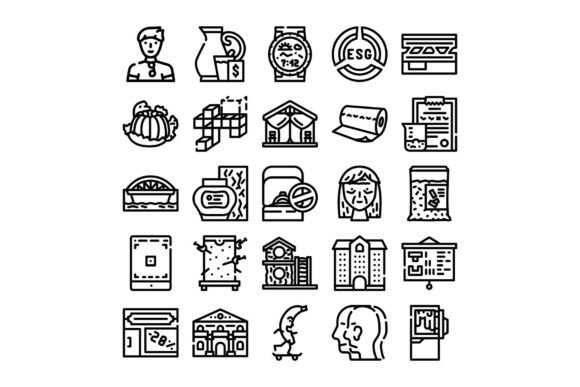
The Collection of Various Objects Symbols an distinguishes itself not by volume alone—but by intentional curation and functional coherence. Each icon is crafted as a line art glyph: single-weight strokes, consistent stroke width, open negative space, and balanced proportions. Unlike photorealistic or skeuomorphic assets, these symbols avoid stylistic noise—making them legible at 16px on a mobile screen or blown up across a conference banner.
Crucially, the collection avoids arbitrary categorization. It doesn’t group icons solely by industry (e.g., “healthcare” or “finance”) but by conceptual function: objects (a key, a globe, a clipboard), symbols (an arrow looping, a checkmark inside a circle, intersecting waves), and abstract concepts (balance, convergence, iteration, reciprocity). This triad-based structure mirrors how humans actually reason—grounding abstraction in tangible reference points while allowing flexibility in interpretation.
Why Line Art? Practical Advantages Across Mediums
Line art isn’t a stylistic preference—it’s a performance decision. Its advantages compound across real-world usage scenarios:
- Resolution independence: SVG-based line art scales infinitely without pixelation—critical for responsive web design, high-DPI displays, and print-ready infographics.
- File efficiency: Minimal path data means tiny file sizes (<1 KB per icon on average), accelerating page loads and reducing bandwidth use—especially valuable for global audiences on slower networks.
- Styling adaptability: Stroke color, width, and dash patterns can be modified via CSS or code, enabling dynamic theming (e.g., switching from blue to amber for accessibility contrast or brand alignment) without swapping assets.
- Accessibility readiness: Clean outlines and uncluttered forms support screen reader labeling and reduce cognitive load for neurodiverse users—particularly when paired with semantic HTML and ARIA attributes.
Consider a public health dashboard tracking vaccination rates across regions. Instead of dense tables or color-coded bars alone, designers integrate line art icons—a syringe for dose type, a calendar for timeline, a shield for immunity status. These aren’t mere embellishments; they serve as visual anchors that accelerate pattern recognition and reduce working memory strain during rapid scanning.
Educators and Instructional Designers
In learning environments—whether K–12 classrooms or corporate LMS platforms—icons from the Collection of Various Objects Symbols an act as cognitive scaffolds. A lesson on water cycles might pair a cloud icon with downward arrows (precipitation), a sun (evaporation), and a droplet (condensation). Research in educational psychology shows that dual-coding—combining verbal and visual cues—improves retention by up to 42% compared to text-only delivery. These icons don’t replace explanation; they compress prerequisite understanding so learners can focus on higher-order analysis.
Product Teams and UX Researchers
During usability testing, teams often map pain points using journey maps. Here, line art icons serve as universal markers: a broken chain link for system integration failure, a clock with a pause symbol for latency issues, a magnifying glass over a question mark for unclear interface feedback. Because the icons avoid cultural specificity (no facial expressions, no localized objects like postal boxes or traffic signs), they remain interpretable across international test cohorts—reducing translation overhead and bias in thematic coding.
Researchers and Data Communicators
Academic papers, policy briefs, and NGO reports increasingly rely on visual summaries. A climate scientist illustrating carbon sequestration pathways might layer icons: a tree (biological capture), a cylinder (geological storage), and interlocking gears (technological mediation). The Collection of Various Objects Symbols an supports such layered storytelling precisely because its symbols are modular—not locked into fixed compositions. Users combine, rotate, and reposition elements without visual dissonance, preserving narrative integrity across formats (PDF, web, presentation slides).
Small Business Owners and Content Creators
For solopreneurs designing service landing pages or social media carousels, time and budget constraints make custom illustration impractical. Yet generic stock icons often feel hollow or mismatched. This collection offers a middle path: professional-grade consistency without licensing friction. A freelance graphic designer promoting branding packages might use a palette icon (object), a lightbulb (concept), and converging arrows (symbol)—all sharing identical stroke weight and rhythm. The result feels bespoke, not templated.
Implementation Considerations: Beyond Drag-and-Drop
Adopting the Collection of Various Objects Symbols an effectively requires more than importing files. Thoughtful implementation includes:
- Contextual hierarchy: Icons should reinforce—not compete with—text. Reserve them for primary actions (e.g., “Download Report”), conceptual anchors (“Core Principles”), or categorical dividers (“Phase 1: Discovery”). Avoid decorative repetition that dilutes meaning.
- Consistent metaphor use: If a gear represents “settings” in one interface section, don’t repurpose it as “automation” elsewhere without clear visual or textual reinforcement. Semantic drift erodes trust in the visual language.
- Localization awareness: While line art minimizes cultural assumptions, some symbols carry subtle regional weight. A house icon may denote “home” universally—but in contexts where multigenerational housing is normative, it may unintentionally imply nuclear-family structures. Pairing icons with concise labels mitigates ambiguity.
- Performance-aware delivery: Serve icons inline as SVGs within HTML for critical-path elements (navigation, CTAs); lazy-load decorative sets via JavaScript. Use
witharia-hidden="true"for purely visual icons, androle="img"with descriptivearia-labelwhen meaning is non-obvious.
How This Collection Fits Within Broader Design Trends
The rise of the Collection of Various Objects Symbols an reflects deeper shifts in digital communication. We’re moving past “flat design” dogma toward functional minimalism: stripping visuals to their semantic essence without sacrificing expressiveness. It aligns with WCAG 2.2’s emphasis on “visual presentation of text and images,” supporting both perceptual clarity and cognitive accessibility.
It also anticipates generative workflows. As AI-assisted design tools mature, line art icons serve as ideal training data—clean vector paths enable reliable interpolation, style transfer, and parametric variation. Designers aren’t just using these icons; they’re building upon them—extending stroke logic to animate transitions, or combining base shapes algorithmically to generate new concept glyphs (e.g., merging a battery and leaf icon to represent “sustainable energy”)
Choosing and Extending the Collection Responsibly
No icon set is universally optimal—and this collection is no exception. Its strength lies in neutrality, which means it intentionally avoids stylistic personality. For brands requiring strong tonal identity (e.g., playful edtech or luxury wellness), pairing it with custom-drawn accents—or selectively modifying stroke ends or corner radii—creates distinction without sacrificing coherence.
When extending the set, prioritize conceptual fidelity over visual novelty. Adding a “blockchain” icon? Focus on its core attributes—decentralization, verification, immutability—rather than literal depictions of chains or ledgers. A repeating hexagon pattern with checkmarks inside each node communicates consensus more abstractly and enduringly than a rendered server rack.
Ultimately, the Collection of Various Objects Symbols an succeeds not because it answers every visual need—but because it provides a shared, extensible foundation. It invites collaboration across roles: developers who embed them, writers who label them, educators who interpret them, and users who intuit them. In an era of fragmented attention and escalating information density, that kind of quiet, consistent utility isn’t just convenient—it’s essential infrastructure.