Diverse Collection of Linear Icons Repre: A Practical Guide for Visual Communication
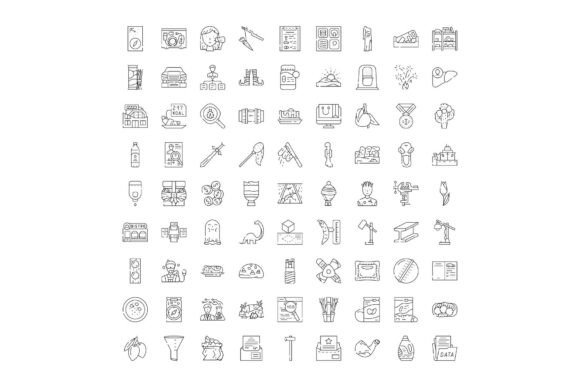
Linear icons—clean, minimalist, stroke-based visual symbols—have become foundational tools in modern digital design. Among the most versatile resources available today is the Diverse Collection of Linear Icons Repre, a thoughtfully curated set that transcends generic icon libraries by emphasizing conceptual breadth, stylistic consistency, and functional adaptability. Unlike collections limited to common UI actions (e.g., “home,” “search,” “settings”), this set deliberately spans tangible objects, abstract ideas, natural phenomena, cultural motifs, and interdisciplinary concepts—from “quantum entanglement” and “neural feedback loop” to “compost cycle,” “oral history,” and “civic participation.” Its strength lies not just in quantity, but in its intentional diversity: each icon is designed as a legible, scalable, and semantically grounded unit within a unified linear language.
Why Linearity Matters in Contemporary Visual Design
The linear style—defined by uniform stroke weight, open contours, and deliberate negative space—offers distinct advantages over filled or gradient-heavy alternatives. It prioritizes clarity at small sizes (critical for mobile interfaces and data-dense dashboards), ensures accessibility through high contrast and uncluttered forms, and supports dynamic theming via simple CSS color or stroke adjustments. More importantly, linearity invites interpretation without prescribing meaning: a single-line wave can represent ocean currents, sound frequencies, or market volatility—context determines resonance. The Diverse Collection of Linear Icons Repre leverages this flexibility intentionally. Its icons avoid excessive detail or realism, instead distilling subjects into essential structural relationships—angle, rhythm, symmetry, and flow—that remain legible across languages, literacy levels, and cognitive processing styles.
Real-World Applications Across Disciplines
Professionals across sectors rely on this collection not as decorative flourishes, but as functional visual scaffolding—bridging gaps between complex information and intuitive understanding.
Educators and Curriculum Designers
In lesson planning and digital learning platforms, educators use icons from the Diverse Collection of Linear Icons Repre to scaffold abstract pedagogical frameworks. For example, “scaffolding,” “zone of proximal development,” and “formative loop” appear as interlocking lines, nested arcs, and cyclical arrows—visual metaphors that reinforce conceptual models without text overload. In science units on climate systems, icons for “albedo effect,” “carbon sequestration,” and “thermal inversion” help students map relationships among invisible processes. These are not illustrations; they’re cognitive anchors—designed to be recognized, recalled, and recombined during inquiry-based learning.
UX Researchers and Product Teams
User interface designers integrate these icons into journey maps, empathy diagrams, and service blueprints where conventional symbols fall short. Consider a fintech app redesign focused on financial literacy for underbanked communities. Instead of relying on universal-but-ambiguous icons like “graph” or “wallet,” teams select “compound growth curve,” “budget boundary,” and “credit-building ladder”—icons drawn from the Diverse Collection of Linear Icons Repre that reflect lived experience, not abstract finance theory. This precision reduces cognitive load and increases trust: users recognize themselves in the visuals, not just the interface.
Public Health Communicators and Policy Advocates
During pandemic response efforts, health departments used icons for “contact tracing network,” “vaccine equity gradient,” and “caregiver burnout threshold” to visualize systemic challenges in stakeholder briefings. Because each icon maintains consistent stroke width and spatial proportion, they scale seamlessly from printed posters to animated explainer videos—preserving meaning across mediums. Crucially, the collection avoids culturally specific symbolism (e.g., handshakes, globes, or doves), opting instead for universally legible structures: overlapping circles for networks, ascending staircases with variable step heights for inequity, and tension lines converging toward a central point for thresholds.
Design Characteristics That Enable Cross-Domain Utility
What makes this collection uniquely effective isn’t novelty—it’s disciplined execution. Four interlocking design principles define its coherence:
- Stroke Integrity: Every icon uses a fixed 2px stroke weight across all sizes (16px to 96px), ensuring optical consistency whether rendered on retina displays or low-resolution projectors.
- Conceptual Anchoring: Each symbol begins with a core metaphor—“resilience” as a spring under compression, “bias correction” as a balanced beam with offset weights—then abstracts it into minimal linework without losing semantic fidelity.
- Contextual Modularity: Icons are built as standalone units but include optional companion elements—dashed outlines for hypothetical states, dotted extensions for iterative processes, or paired directional arrows for bidirectional flows—allowing designers to compose layered meaning without custom illustration.
- Color-Agnostic Structure: While the collection includes suggested palettes (including WCAG-compliant contrast pairings), every icon functions monochromatically. This supports dark mode adaptation, print workflows, and assistive technology compatibility without requiring alternate assets.
Implementation Considerations for Creators and Developers
Adopting the Diverse Collection of Linear Icons Repre goes beyond drag-and-drop usage. Thoughtful integration requires attention to workflow, scalability, and ethical framing.
For developers, SVG implementation is strongly recommended over icon fonts. SVGs preserve vector fidelity, support inline styling (e.g., stroke="#2563eb"), and allow dynamic manipulation—such as animating a “data synchronization” icon by sequentially revealing connecting lines. When embedding in React or Vue components, treat icons as reusable primitives with accessible labels (aria-label) and focus management—not decorative images.
For creators working in Figma or Adobe XD, the collection includes organized layers: base strokes, optional annotations, and alignment guides. This structure supports rapid customization—like adjusting stroke ends from round to square for technical documentation—or combining multiple icons into composite diagrams (e.g., layering “supply chain,” “blockchain ledger,” and “ethical audit” to visualize responsible sourcing).
A critical, often overlooked consideration is semantic responsibility. Linear icons simplify—but they don’t neutralize. Using an icon for “migration” as a simple arrow risks erasing complexity; selecting one from this collection that incorporates layered paths, divergent endpoints, and weighted line density signals nuance. The Diverse Collection of Linear Icons Repre includes usage guidance notes for sensitive concepts—reminding designers that visual economy must never come at the cost of contextual honesty.
Emerging Trends Shaping Icon Use Today
Three shifts are redefining how professionals engage with iconography—and why this collection remains relevant amid rapid change:
- From Action-Oriented to Meaning-Oriented Icons: Early UI icons centered on verbs (“save,” “print,” “share”). Today’s demands—climate reporting, AI ethics dashboards, participatory budgeting—require nouns and abstractions that convey systems, values, and relationships. The Diverse Collection of Linear Icons Repre anticipates this by dedicating over 40% of its library to non-action concepts.
- Dynamic Contextualization: Static icons are giving way to context-aware variants. A “water cycle” icon may display evaporating mist in drought reports but saturated droplets in flood alerts—achieved through lightweight SVG classes rather than separate assets. This collection’s modular construction enables such adaptations without bloating asset libraries.
- Co-Creation and Localization: Organizations increasingly involve community stakeholders in visual lexicon development. The collection’s open licensing framework (CC BY-SA 4.0) permits derivative works—so a rural education NGO can adapt “digital literacy” to reflect local device usage (e.g., feature phones vs. tablets) while preserving the underlying linear grammar.
Choosing and Extending the Collection Responsibly
No icon set replaces domain expertise—but a well-designed one amplifies it. When evaluating whether the Diverse Collection of Linear Icons Repre fits your needs, ask three questions:
- Does it contain at least three icons that directly map to core concepts in your current project—not just adjacent ones?
- Can you combine two or more icons meaningfully without visual conflict (e.g., “algorithmic bias” + “community review” forming a coherent diagram)?
- Does its documentation clarify intended interpretation—not just label names, but conceptual boundaries and common misreadings?
For long-term use, consider building internal extensions: annotate icons with brief explanatory tooltips, create annotated style guides showing stroke weight application across devices, or develop a shared taxonomy linking icons to research findings or policy documents. The collection’s strength grows not from passive consumption, but from active, reflective engagement—treating each linear form as both tool and provocation.
Ultimately, the Diverse Collection of Linear Icons Repre succeeds because it treats visual communication as a collaborative practice—not a delivery mechanism. Its icons don’t shout for attention; they invite pause, recognition, and connection. Whether sketching a workshop activity, prototyping a civic tech platform, or visualizing longitudinal research data, these linear forms offer something increasingly rare in digital spaces: quiet precision with expansive resonance.