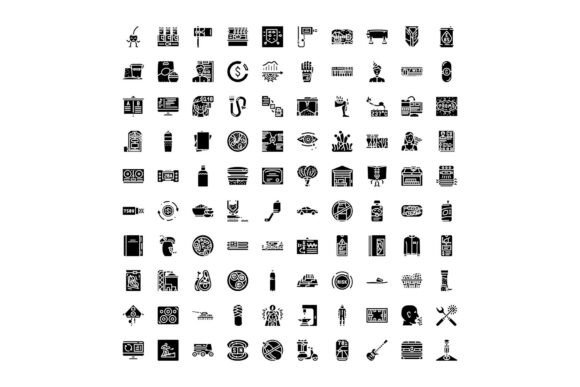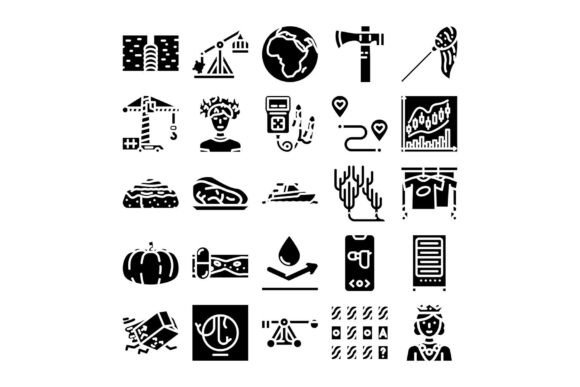
Collection of Business, Nature, and Tech: A Versatile Glyph Icon Set for Modern Digital Design
Icons are the silent ambassadors of digital interfaces—small but mighty visual cues that guide users, clarify actions, and reinforce brand identity. Among today’s growing library of icon resources, the Collection of Business, Nature, and Tech stands out not for flashiness, but for thoughtful breadth and real-world utility. Designed with clarity and adaptability in mind, this diverse glyph icon set spans seven core domains: construction, nature, finance, food, clothing, tech, and abstract symbols. Whether you're sketching a wireframe, building an app dashboard, or designing an infographic for sustainability reporting, these icons offer consistent styling, intuitive recognition, and cross-context flexibility.
What Makes This Collection Different?
Unlike many icon sets that prioritize aesthetic uniformity at the expense of meaning, the Collection of Business, Nature, and Tech balances visual cohesion with semantic precision. Each glyph is crafted to reflect its category authentically—think a stylized crane for construction, a leaf-and-circuit hybrid for eco-tech, or a minimalist piggy bank paired with a chart for finance—not as decorative flourishes, but as functional tools.
The collection uses a clean, scalable vector format (SVG-ready), ensuring crisp rendering across devices—from smartwatch displays to large-format presentation screens. Stroke weight, corner radius, and negative space are harmonized across categories, so switching from a food-related icon (e.g., a steaming bowl) to a tech symbol (e.g., a data node) feels seamless—not jarring.
For Web & App UI Designers
UI designers often face the challenge of communicating complex functions with minimal visual clutter. The Collection of Business, Nature, and Tech excels here: a single icon can replace a label in a navigation bar (e.g., a gear-and-leaf combo for “Sustainability Settings”), serve as a status indicator (a shield-with-coins for “Secure Payment”), or act as a visual anchor in onboarding flows. Because icons share proportional logic and spacing conventions, they integrate smoothly into design systems without requiring custom overrides.
For Infographic Creators & Content Marketers
Infographics rely on rapid comprehension. With this collection, you can illustrate a supply chain story using construction (factory), nature (forest), and tech (cloud server) glyphs side-by-side—each distinct yet stylistically unified. Finance icons like upward-trending arrows or balanced scales help visualize budget reports; food and clothing glyphs support lifestyle or wellness content without needing custom illustrations. No more hunting across three different libraries for matching styles.
For Small Business Owners & Solopreneurs
You don’t need a design team to build professional-looking materials. A local café owner can use food icons for their menu PDF, nature glyphs for a “farm-to-cup” story section, and tech symbols for online ordering instructions—all drawn from the same cohesive set. Likewise, a freelance financial advisor might pair finance icons (bar charts, vaults) with abstract symbols (arrows, nodes) to explain investment strategies in client presentations—without licensing complications or style mismatches.
Who Benefits Most—and Why
- Product Managers: Quickly prototype feature roadmaps using abstract and tech glyphs to represent APIs, integrations, or AI components—while weaving in nature or finance icons to signal ESG goals or revenue impact.
- Educational Platform Developers: Teach interdisciplinary topics—like green energy—with construction (wind turbine), nature (sun), and tech (battery) icons used together in interactive modules.
- Sustainability Report Designers: Visualize metrics across sectors: forest coverage (nature), renewable infrastructure (construction + tech), and ethical sourcing (clothing + leaf).
- Nonprofit Communicators: Convey mission-driven narratives—food security (grain + hands), climate action (tree + cloud), or inclusive finance (group + coin)—with immediate emotional resonance and clarity.
Strengths You Can Rely On
The Collection of Business, Nature, and Tech delivers where many icon sets fall short:
- Cross-domain coherence: Icons don’t just look alike—they behave alike. Hover states, active indicators, and responsive sizing rules apply consistently—even across categories.
- Context-aware versatility: A single “circuit leaf” glyph works equally well in a climate-tech startup pitch deck and a municipal smart-city dashboard.
- Accessibility-first foundations: Icons include built-in ARIA labels and contrast-optimized variants, supporting WCAG-compliant implementations out of the box.
- Licensing simplicity: One license covers web, mobile, print, and internal use—no per-seat fees or attribution requirements for standard projects.
Real-World Scenarios: How Teams Use It Today
A regional bank redesigned its mobile app to highlight green financing options. Instead of generic “eco” icons, they used the Collection of Business, Nature, and Tech to pair a sprouting seed (nature) with a loan document (finance) and a solar panel (tech)—creating an instantly recognizable, ownable visual motif for their new product line.
An urban planning nonprofit launched an interactive map showing neighborhood development projects. They layered construction cranes, native plant silhouettes, and open-data badges (abstract + tech) from the same set—ensuring users could distinguish project types at a glance while sensing thematic unity.
A meal-kit startup built a dynamic ingredient tracker for its app. Using food glyphs (tomato, basil, grain), clothing icons (for reusable packaging tags), and nature symbols (compost bin, raindrop), they communicated sustainability values without text-heavy explanations—reducing cognitive load and increasing engagement.
What to Keep in Mind: Practical Considerations
While versatile, the Collection of Business, Nature, and Tech isn’t designed to replace highly specialized iconography—like medical device schematics or aerospace controls. Its strength lies in general-purpose clarity, not domain-deep specificity. If your project demands ultra-niche metaphors (e.g., quantum computing diagrams or vintage textile patterns), supplemental assets may still be needed.
Also note: the collection emphasizes symbolic interpretation over literal illustration. A “clothing” icon may be a simplified hanger or folded shirt—not a photorealistic garment. That’s intentional: it supports scalability, fast loading, and conceptual flexibility. Users accustomed to hyper-detailed icons may need a brief adjustment period—but most find the cleaner approach improves scannability and translation across languages.
Evaluating Fit for Your Project
Ask yourself:
- Do you need icons that work across multiple themes—not just one vertical?
- Is consistency in tone and technical implementation more valuable than stylistic novelty?
- Will your audience benefit from intuitive, cross-cultural recognition—rather than culturally specific references?
- Are you balancing speed (of design and development) with long-term maintainability?
If you answered “yes” to most of these, the Collection of Business, Nature, and Tech is likely a strong match. It’s especially effective when your work bridges disciplines—like agritech dashboards, ethical fashion e-commerce, or fintech tools for environmental nonprofits.
Final Thought: Icons as Shared Language
In an era of fragmented digital experiences, shared visual language matters. The Collection of Business, Nature, and Tech doesn’t try to be everything—it aims to be usefully everything enough. It meets creators where they are: balancing business pragmatism, ecological awareness, and technological fluency—not as separate concerns, but as interwoven realities. Whether you’re mapping carbon footprints or streamlining checkout flows, these glyphs offer quiet confidence: clear, consistent, and ready to communicate without explanation.
Explore how the Collection of Business, Nature, and Tech can simplify your next design sprint, strengthen your data storytelling, or deepen user trust—by saying more, with less.